Curated Funny Quotes: Unlock Deeper Engagement for Your Content Teams

Why curated funny quotes matter for creative teams
Many businesses struggle to make their content truly special.

In 2026, it’s harder than ever for creative teams to find fresh and original humor that really connects with their audience. Think about it: with so much content out there, a lot of it starts to look and sound the same. This is especially true when artificial intelligence creates much of what we see online, leading to a sense of "AI-generated sameness," as noted in the Social-First Trends 2026 report.
It’s not enough to just throw in any old joke. Content teams need to find audience-appropriate humor, like the perfect funny quotes, that makes people stop and pay attention. Generic humor or common irony examples might not work well for a serious business audience. What might be seen as funny jokes for adults on a comedy show could be out of place in a marketing email. Even simple corny jokes need to be used with care to avoid making content feel weak instead of witty. The real challenge is finding humor that is both original and fitting, helping your brand stand out.
This is where understanding and curating funny quotes comes in. This guide will help you learn practical ways to find unique and clever humor for your content. We’ll show you how to choose quotes that truly fit your brand and your audience. You’ll also learn how to use these quotes in a way that builds trust and makes your content more memorable. We’ll even cover how to check if your funny content is making a real impact. If you’re ready to explore how to turn strange ideas into clever comedy, then you might be an Absurd Humor Fans.
To get started, learning how to select engaging visual humor can be a great first step. Discover tips on how to find funny photos that boost social media engagement.
Why funny quotes work: psychology, memory, and shareability
After learning how important it is to find unique and fitting humor for your content, let’s look at why certain types of humor, especially short and sweet funny quotes, truly connect with people. It’s not magic, it’s just how our brains work!

There are a few clever reasons why funny quotes stick with us.
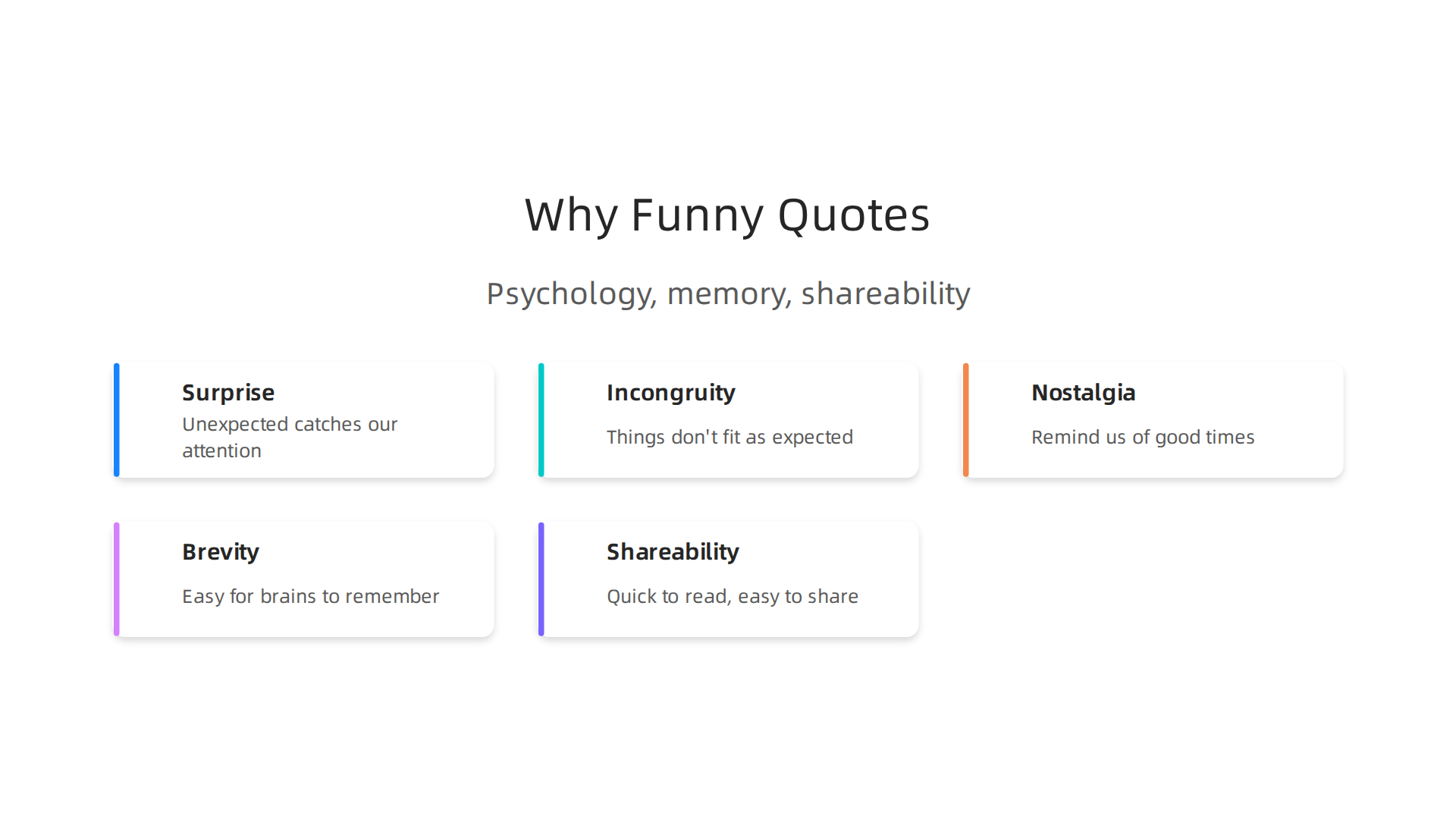
First, humor often comes from surprise. When something unexpected happens or is said, it catches our attention and makes us laugh. Imagine reading something serious, and then a funny quote comes out of nowhere. That sudden twist is what makes it memorable.
Next is incongruity. This is a fancy word for when things don’t quite fit together in a way we expect. For example, a very proper person saying something silly, or a serious situation having a touch of light humor. Things like good irony examples play on this feeling. When our brains see something that doesn’t quite match up, we find it amusing.
Sometimes, humor works because of nostalgia. Funny quotes that remind us of good old times, shared jokes, or funny memories can make us feel happy and connected. It’s like an inside joke that many people understand, making the content feel more personal. Even simple corny jokes can create a sense of lightheartedness and shared experience if they hit the right note.
Beyond psychology, funny quotes are easy to remember because they are short. Our brains are better at holding onto small pieces of information. A long story might be forgotten, but a quick, witty quote can stay with us all day. This brevity also makes them perfect for sharing. In 2026, people love to share content that is quick to read and easy to understand. Think about how many short videos and funny texts fly around online every day. Short, funny quotes fit right into this fast-paced world, making them super shareable. This quick sharing of funny, short content is a big part of how things go viral today, especially with how popular short-form video content has become, as noted in research on The Effectiveness of Short-Form Video Content.
So, when you choose funny quotes for your content, you’re not just throwing in a joke. You’re tapping into how people think, feel, and share. You’re using surprise, clever mismatches, and warm memories to make your content truly stand out and be remembered.
Categories of funny quotes every content team should know
Now that we know why certain funny quotes work so well with people, let’s talk about the different kinds you can use. Picking the right kind of humor is like picking the right tool for a job. Each type of funny quote has its own special way of connecting with your audience. Understanding these categories helps your team choose the best humor for any content you make in 2026.
Here are some main categories of funny quotes to think about:
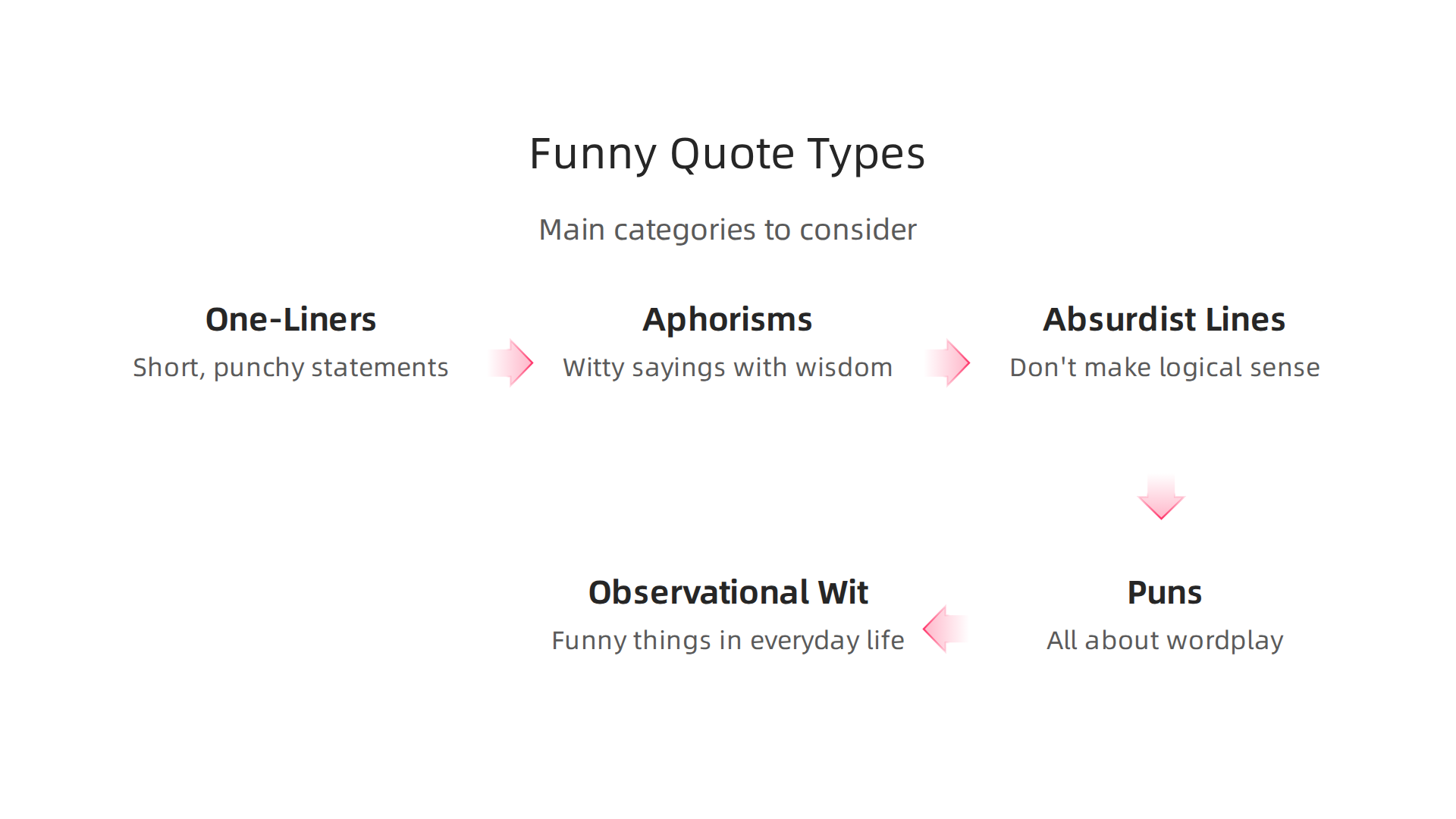
- One-Liners: These are short, punchy statements designed to get a quick laugh. They’re often very direct and surprising. One-liners are great for social media posts, quick captions, or as a way to start or end a short piece of content. Because they are so brief, they are easy to remember and share.
- Aphorisms: Think of these as witty sayings that often have a bit of wisdom or a clever observation mixed in. They’re not just funny, they also make you think. Aphorisms work well in blog posts, presentations, or anywhere you want to add a deeper, thoughtful layer to your humor. They can be like funny jokes for adults that carry a hidden meaning.
- Absurdist Lines: These funny quotes don’t make logical sense, and that’s exactly what makes them funny. They play with strange ideas and unexpected twists, often creating a surreal or very unusual picture in your mind. This type of humor can be very engaging for audiences who enjoy unique and non-traditional comedy. Some studies even look into how people react to humor that might be seen as tricky or "deceptive" because it breaks normal expectations, as explored in research on Deceptive Humor.
- Puns: Puns are all about wordplay. They use words that sound alike but have different meanings, or words that have multiple meanings, to create a silly or clever effect. While some people love them, others might groan! Puns are great for lighthearted content, brand names, or playful social media interactions, if you know your audience enjoys them.
- Observational Wit: This kind of humor comes from pointing out funny or strange things we all notice in everyday life. It’s relatable because it often highlights common experiences, making people say, "Oh, I know exactly what they mean!" Observational wit has broad appeal and can make your content feel very human and down-to-earth. Even simple corny jokes sometimes use observation to connect with a wide audience.
Knowing these different types lets you pick the perfect funny quotes for your message. Whether you’re aiming for a quick laugh or something that makes people think, there’s a type of humor for every need. Learning various comedy techniques from different sources can help you master these categories.
Now that you know the different kinds of funny quotes you can use, it’s super important to know how to use them the right way. When you want to share witty sayings or create your own original humor, you need to think about legal and ethical rules.

This helps you avoid problems and make sure everyone gets credit for their ideas.
Let’s look at what you need to check before using or making funny quotes.
Understanding Copyright and Public Domain
First, let’s talk about copyright. Copyright is like a special key that protects original works, like books, songs, and yes, even certain funny quotes or unique phrases. It gives the creator the right to control who copies or uses their work. In 2026, copyright rules mean that most works are protected for a long time, often 70 years after the creator passes away, as explained by resources on Copyright basics. You can learn more about these rules from the U.S. Copyright Office.
But not everything is protected by copyright forever. Some things enter the "public domain." This means the copyright has run out or never existed, so anyone can use these materials without asking for permission. For example, many old works are in the public domain. Also, most materials from the U.S. Government are in the public domain unless it says otherwise, as noted in resources on Frequently Asked Questions about Copyright – State.gov and Public Domain – UBC Copyright – The University of British Columbia. Knowing what’s in the public domain helps you find funny quotes you can use freely.
Giving Credit: Attribution Best Practices
Even if a funny quote is in the public domain, it’s still good practice to say where it came from if you know. This is called attribution. Giving credit is not just polite, it also helps your audience see you as trustworthy. For instance, if you’re sharing a classic funny quote, mentioning the person who said it originally is a good idea. This is especially true for well-known figures or for quotes that might sound like clever irony examples. Always try to find the original source if you can.
Licensing and Permission
Sometimes, you might want to use a quote that is still protected by copyright. In these cases, you might need to get permission from the creator or pay for a license. This is more common for longer pieces of text or for commercial uses. For short funny quotes, especially if you’re using them in a way that falls under "fair use" (like for review or comment), you might not need permission. However, fair use can be tricky, so it’s always best to be careful.
Ethical Guidelines for Adapting Quotes
What if you want to change a quote a little bit or make it your own? This is where ethics come in.
It’s okay to be inspired by funny quotes you read and then create your own version. The key is to make sure your new quote is truly your original work and not just a slightly changed copy. You want to avoid plagiarism, which is taking someone else’s words and pretending they’re your own.
Here’s how to do it right:
- Understand the Core Idea: Really grasp what makes a quote funny. Is it observational wit, a clever pun, or a smart one-liner?
- Rephrase Completely: Instead of just changing a few words, try to express the same idea in a totally new way. Use different words, sentence structures, and humor techniques.
- Preserve Intent: If you’re adapting someone else’s idea, make sure you don’t twist their original meaning in a bad way.
- When in Doubt, Create Original: If you’re not sure if your new quote is original enough, it’s always better to come up with something completely new. This is especially true if you want to create original content or even funny jokes for adults that stand out.
By following these legal and ethical steps, your content team can confidently curate and create funny quotes. This ensures your humor is both enjoyable and respectful of others’ creativity. If you love discovering truly original and surprising comedic content, you might be interested in exploring new forms of humor.
Are you an Absurd Humor Fans? This series turns strange ideas into clever comedy.
Writing and adapting quotes for your audience and tone
When you make or share funny quotes, it’s super important to think about who you’re talking to and how you want to sound. Different groups of people find different things funny, and what works for one person might not work for another. This means you might need to change a quote a little bit to fit your audience.
Think about these things when you are getting your funny quotes ready:
- Who is listening? Are they kids, teens, or adults? What are their interests? For example, a joke about school might not land well with people who finished school a long time ago.
- Voice and Style: Does your audience like silly humor, smart humor, or something in between? Some people like simple, corny jokes, while others prefer more clever irony examples. You might need to change the words or the way you say them to match.
- Length: Sometimes, a shorter, punchier funny quote is better. Other times, a longer story can build up the humor. Make sure the quote isn’t too long for your audience to enjoy.
- Cultural References: Jokes often use ideas or sayings that are common in one culture. But these might not make sense to people from different places. Adapting humor across cultures can be tricky, as humor often relies on shared knowledge and experiences, as explained in articles about The Challenges of Translating Humor Across Cultures. You might need to swap out specific names or places for ones your audience will understand.
Making sure your humor fits
The tone of your funny quotes should match your overall message. Are you trying to be light and fun, or are you trying to make a clever point? Keep the original meaning of the quote, but adjust how it’s told. If you’re trying to make funny jokes for adults, you might use more grown-up topics.
Here’s a quick checklist to help you edit your quotes:
- Is it clear? Make sure everyone will understand what’s funny.
- Is it kind? Will anyone feel hurt or left out? Good humor is usually something everyone can laugh at together.
- Is it fresh? Even classic funny quotes can feel new if you deliver them in a fresh way.
- Is it too long? Can you make it shorter without losing the funny part?
- Does it fit your audience? Imagine saying it to them. Will they smile?
By looking at these things, you can make sure your funny quotes are always a hit. Learning how to be smart and funny with your content is a great skill. You can learn more about how to do this by looking at Lindsay Lohan Comedy Movies Teach Content Creators How to Be Funny and Smart. This makes your content enjoyable and helps you connect better with your audience.
Adapting cultural references and idioms
When you’re telling funny quotes or jokes, some ideas, phrases, or names might be very special to a certain place or group of people. These are called cultural references or idioms. Think of an idiom like "raining cats and dogs," which means it’s raining a lot. If someone doesn’t know that saying, they might get confused!
It’s important to decide if you want to change these references or keep them. If you’re talking to people from many different places, it’s often better to change your funny quotes so everyone can understand. You want to make sure your humor connects with as many people as possible. Making jokes travel well across different groups can be tricky, as shown in studies on Humor in Translation and What It Can Entail.
But if you know your audience shares the same background, keeping those special references can make the funny jokes for adults even funnier, because they’ll get the inside joke. This can also apply to specific types of humor, like understanding irony examples.
Here are some quick ways to check if your funny quotes will land well with your audience:
- Will most people get it? Think about if the reference is too local or too old for your audience. If it’s a very specific sports team name, will everyone know it?
- Could it be misunderstood? Sometimes, a word or phrase in one culture might mean something else in another. You don’t want to accidentally make someone feel bad or confused.
- Is there a simpler way to say it? If the cultural reference makes the joke too hard to understand, maybe you can swap it for a more universal idea. Even if it’s a bit of a corny joke, clear is usually better.
By checking these things, you can make sure your funny quotes are understood and enjoyed by everyone you’re sharing them with. You can also explore how different types of humor are created in pieces like Hollywood Action Stars Teach the Comedy Techniques That Strengthen Your Content Strategy. This helps your message shine through.
After making sure your funny quotes make sense to everyone, the next important step is to make them short and catchy. In 2026, people often look at many things quickly, so their attention span can be quite short. You want your funny quotes and funny jokes for adults to grab attention right away and keep it.
How you share a funny quote changes how much you need to trim it.
- For a caption: If your funny quote is a caption under a photo or video, you have a little more room. You can use a few more words to set up the joke, but still aim for quick impact.
- For an image quote: If your quote is meant to be put right on an image, it needs to be very short. Think of just the key words. People will see the image and read the short text quickly. This is where every word counts. To learn more about making visual content work, you might check out how to How to Find Funny Photos That Boost Social Media Engagement.
Here are some small changes you can make to keep the joke strong:
- Cut extra words: Read through your funny quote. Are there any words that don’t absolutely need to be there? Take them out. Often, simpler is funnier. Even if it’s a bit of a corny joke, unnecessary words can ruin the flow.
- Keep the surprise: The best funny quotes have a surprise at the end, called a punchline. Make sure you don’t cut the part that makes it surprising. The setup should be short, and the punchline clear. Understanding the parts of humor is key, as explored in "Relevance, humour and translation Introduction", which often focuses on jokes as key examples of speaker’s intent and audience perception Relevance, humour and translation Introduction.
- Check the rhythm: Read your shortened quote out loud. Does it sound good? Does it flow well? The timing of a joke is very important. If it sounds clunky, try moving words around or cutting more.
- Focus on the core idea: What is the main point or funny idea of your quote? Make sure that core idea shines through, even if you have to remove some details. This is true whether you’re explaining irony examples or just a simple, funny observation.
By doing these small edits, you make sure your funny quotes hit just right, no matter where you share them.
Once you know how to make your funny quotes short and easy to understand, the next step is to find really good ones that aren’t used everywhere. It’s like finding a special toy that not everyone has. In 2026, many jokes and sayings get shared so much that they become old quickly. You want fresh, clever humor that stands out, whether it’s a simple funny quote or a more complex irony example.
Where to Find Great Humor
To find unique and funny quotes, you should look beyond the first few results on the internet. Think of it like a treasure hunt!
- Read Books by Funny People: Look for books written by essayists and humorists. These are people who write funny stories and observations for a living. They often have a special way with words that makes their funny jokes for adults truly original. You can also find Best Quotes About Libraries Librarians and Library and Information Science for some interesting ideas.
- Look at Special Collections: Sometimes, people put together books or websites that collect jokes and quotes on a very specific topic. These are called niche anthologies. Since they are so focused, they often have funny quotes you haven’t heard a thousand times. Websites like Goodreads also have sections where you can find quotes based on keywords, which is a form of Showing all quotes that contain ‘curation’.
- Think About Curation: "Curation" means carefully choosing and organizing things. When you are looking for funny quotes, you are acting like a curator. Someone who is Exciting News – I’ll Be Curating An Anthology! is doing a lot of careful work to find the best pieces. You can do the same.
How to Pick the Best Funny Quotes
Even when you find a good source, you still need to check if the funny quote is right for you. Here are some simple rules:
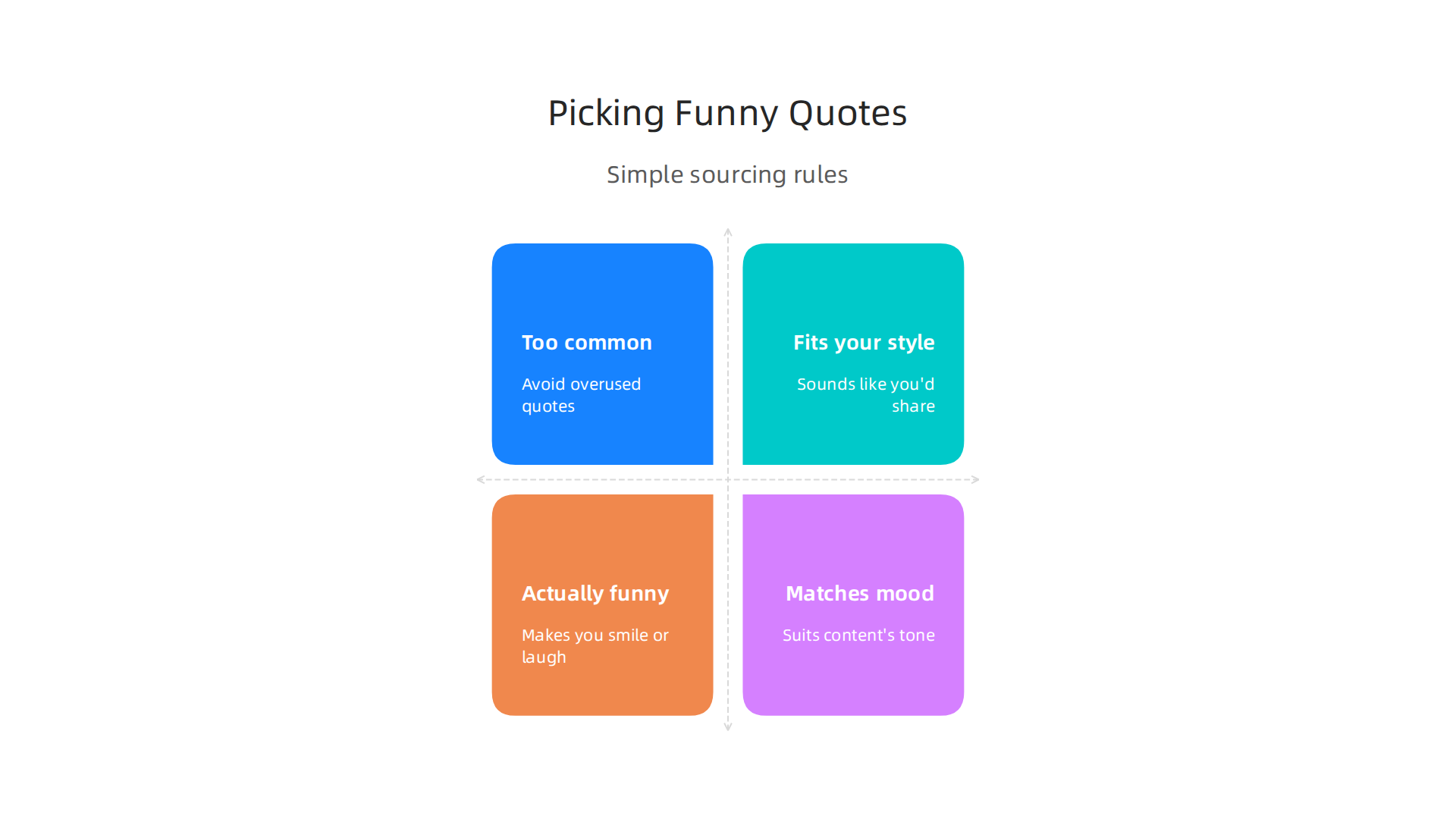
- Is it too common? If you’ve seen the quote everywhere, it might be a bit overused. You want to surprise people with something they haven’t heard.
- Does it fit your style? Think about what kind of humor you like. Is it silly, smart, or a little bit of both? Make sure the funny quote sounds like something you would say or share.
- Is it actually funny? Sometimes, a joke can just be a "corny joke" that tries too hard. The best funny quotes make you smile or laugh easily. They often have a smart twist, like many good irony examples.
- Does it match the mood? A very silly quote might not fit if you’re trying to share something thoughtful, even if it’s still lighthearted.
By finding fresh sources and checking each funny quote carefully, you can make sure your humor always feels new and special. For more insights into how to use specific types of humor to engage your audience, consider exploring how John Travolta Comedic Roles Reveal the Formula for Niche Humor.
If you enjoy humor that takes strange ideas and makes them clever and funny, you might be interested in a unique collection. Explore more for Absurd Humor Fans.
Now that you know how to pick out the best humor, let’s look at some funny quotes and how you can use them in different places. Good funny quotes can make your social media posts brighter, your emails more fun to read, and your longer writings more interesting.
Examples: Best Funny Quotes for Social, Email, and Long-Form
When you share funny quotes, think about where they will go. A short, quick joke works well for social media, while a longer, smarter one might be better for an email or a blog post.
For Social Media: Keep it Short and Punchy
Social media is all about quick smiles. You want funny quotes that people can read fast and easily share.
- "My bed is a magical place where I suddenly remember everything I was supposed to do."
- "I’m not lazy, I’m on energy-saving mode."
These are simple, easy-to-understand funny jokes for adults that many people can relate to. They aren’t trying to be too deep or complex. If you’re looking for many quick ideas, you can find more Funny Caption Ideas for Instagram and Any Photo in 2026.
For Email: A Little More Detail
In emails, you can use slightly longer funny quotes to add a friendly touch or break up serious information.
- "I’ve got a to-do list that’s longer than my patience."
- "The only thing I’m committed to right now is my coffee."
These offer a small chuckle and show your personality. They are not like corny jokes; they have a bit more wit.
For Long-Form Content: Smart and Thought-Provoking
For blog posts, articles, or other longer writings, you can use funny quotes that make people think or show a deeper understanding of a topic. These might even include good irony examples.
- "The only thing worse than a bad day is trying to explain it with a straight face."
- "My computer’s password is the last thing I’d ever tell a stranger. So, essentially, ‘StrangerDanger2026’."
These funny quotes can set a tone, introduce a point, or even lighten up a more serious discussion. You might find inspiration in collections like Top 20 B2B Content Marketing Quotes for 2026.
Giving Credit and Making Small Edits
When you use someone else’s funny quotes, it’s good to give them credit. This shows respect for their work. If you use quotes that are very old, they might be in the "public domain," which means anyone can use them without asking for permission. Works enter the public domain when their copyright runs out. However, for most recent funny quotes, try to mention the author if you know it.
You can also make small changes to a quote to better fit your voice or the situation. For example, changing a few words might make it sound more like you. Just be careful not to change the main idea or the humor of the quote. The goal is to make it feel natural, not to take credit for someone else’s original joke.
To make sure your humor is truly unique and stands out, you might enjoy exploring new kinds of funny ideas. If you appreciate smart, unusual humor, you’ll love this next step.
Try Smarter Absurdity
Once you have great funny quotes, the next step is to know if they are working. How do you measure if people like your funny jokes for adults, or if your clever irony examples are hitting the mark? This is where looking at how things perform and how you share them becomes very important.
Measuring Impact: KPIs, A/B Tests, and Distribution Strategies
To know if your funny quotes are doing well, you need to look at certain numbers.

These are called Key Performance Indicators, or KPIs. They help you understand what’s working and what isn’t.
Knowing if Your Funny Quotes Work: What to Look At
When you share funny quotes, especially online, here are some things to check:
- Likes and Reactions: Do people click the "like" button or use other reaction emojis? This shows they felt something positive.
- Shares: When people share your funny quotes with their friends, it means they really liked it and want others to see it.
- Comments: Are people writing comments? Maybe they’re adding their own funny lines or saying how much they agree. This is a great sign of engagement.
- Clicks: If your funny quote leads to another page, like a blog post, check how many people clicked that link.
For emails, you can look at how many people opened your email (open rate) and how many clicked on links inside (click-through rate). These numbers tell you if your humor caught their eye.
Trying Things Out with A/B Tests
Sometimes, you might have two funny quotes and you’re not sure which one is better. This is where A/B testing comes in handy. It means you show one version (A) to half of your audience and another version (B) to the other half. Then, you look at the KPIs to see which one did better. For example, you might try two different funny quotes in your social media posts to see which gets more shares. This helps you learn what kind of humor your audience likes best. Even small differences can show you a lot about your audience’s taste in funny jokes for adults, or if they prefer clever irony examples over more straightforward humor.
Getting Your Funny Quotes Out There: Distribution
After you know which funny quotes work best, you need to share them in the right places. This is called distribution.
- Social Media: This is a top spot for quick, funny content. Platforms like TikTok and Instagram are huge for short videos and posts in 2026. Studies show that short-form video content can be very effective in grabbing attention and engaging audiences, so consider pairing your funny quotes with engaging visuals or quick clips The Effectiveness of Short-Form Video Content. Looking at current trends, social intimacy is also a big part of what makes content popular this year Social-First Trends 2026.
- Blogs and Websites: Longer funny quotes or thoughtful humor can make your articles more engaging.
- Newsletters: Emails with a touch of humor can make your readers smile and look forward to your next message.
Think about where your audience spends their time. If you want to boost how many people see and like your social media posts, learning How to find funny photos that boost social media engagement can be really helpful. It’s not just about the words, but how they look too.
By carefully watching how your funny quotes perform and sharing them wisely, you can make sure your humor reaches the right people and makes them laugh.
Summary
This article explains why curated funny quotes matter for creative teams and how to use them effectively in 2026’s crowded, AI-shaped content landscape. It covers the psychology behind short humorous lines—surprise, incongruity and nostalgia—and why brief quotes are memorable and shareable. You’ll learn practical categories (one-liners, aphorisms, puns, absurdist lines, observational wit) and where each category fits—social posts, emails, or long-form content. The guide explains legal and ethical steps like copyright checks, attribution, and how to adapt or rewrite quotes responsibly. It gives concrete editing tips to shorten and sharpen punchlines, advice on handling cultural references, and sourcing strategies for fresh material. Finally, it shows how to measure success with KPIs and A/B tests so teams can iterate on what actually engages their audience.