
John Hughes Movies Still Define Comedy for Generations

Why John Hughes Still Defines Comedy for Generations
You know that feeling when you watch a movie from the 80s and it still makes you laugh just as hard as it did back then? That is the magic of John Hughes movies.

He created some of the most beloved teen and adult comedies of the 1980s and 1990s. Films like The Breakfast Club, Ferris Bueller’s Day Off, and Home Alone are not just funny. They feel real. His characters talk and act like people you actually know.
According to the BFI, his essential films include National Lampoon’s Vacation, Sixteen Candles, and Weird Science. These movies earned huge box office numbers because they connected with audiences on a personal level. Hughes never went for cheap laughs. Instead, he blended sharp, witty dialogue with characters you care about. That is a lesson every content creator can use.
For anyone who makes videos, writes scripts, or builds a brand today, studying his filmography is like finding a blueprint for humor that lasts. His approach is the reason we still quote lines from his movies in 2026. If you want to see how other actors have mastered similar comedy techniques, check out our breakdown of Anna Kendrick movies and the lessons they offer for boosting engagement.
And if you are a fan of clever, witty humor that goes beyond the ordinary, you might enjoy Try Smarter Absurdity. It is packed with the kind of unexpected comedy that John Hughes fans love.
The John Hughes Cinematic Universe: A Blueprint for Relatable Comedy
Here is what made John Hughes movies different from everything else playing at the multiplex. He understood that the best comedy comes from truth. Not punchlines. Not gags. Real, messy human truth.
Think about The Breakfast Club. Five teenagers stuck in detention. They have nothing in common. Or so they think. By the end, they realize they are all fighting the same battles. Pressure from parents. Fear of being judged. The need to be seen for who they really are.

That is not just a teen movie. That is life.
Hughes did not invent the teen movie. But he did reinvent it. Before him, teen films were mostly beach parties or horror flicks. The BFI lists Sixteen Candles and The Breakfast Club as essential viewing because they gave teenagers real emotions for the first time. He treated young people like actual human beings with real problems. That emotional depth is why those films still feel fresh in 2026.
His casting choices were just as smart. Hughes loved working with ensembles. He put actors together who had natural chemistry. Think about the group in The Breakfast Club. Molly Ringwald, Emilio Estevez, Judd Nelson, Ally Sheedy, Anthony Michael Hall. Each one brought a different energy. Together, they created something real. The same magic happened in Home Alone. Macaulay Culkin carried the whole movie because Hughes knew how to build a story around one strong, funny kid. If you want to see a similar kind of casting genius, check out our breakdown of Lindsay Lohan comedy movies and what they teach about mixing humor with heart.
The box office numbers prove this approach worked. According to Ultimate Movie Rankings, the average John Hughes movie grossed over $107 million when adjusted for inflation. Home Alone was his biggest hit. But even smaller films like Ferris Bueller’s Day Off earned $70.7 million. Those numbers are not luck. They come from making audiences care.
Hughes wrote about experiences everyone shares. Feeling awkward at school. Fighting with your family. Wanting one perfect day where everything goes right. Those themes cross generations and cultures. That is why his films still play on streaming services today. That is why we still quote lines from Planes, Trains and Automobiles every Thanksgiving.
Here is the lesson for anyone creating content in 2026. Do not try to be funny just to be funny. Find the truth underneath the joke. Build characters your audience sees themselves in. Cast your content with voices that feel authentic together.
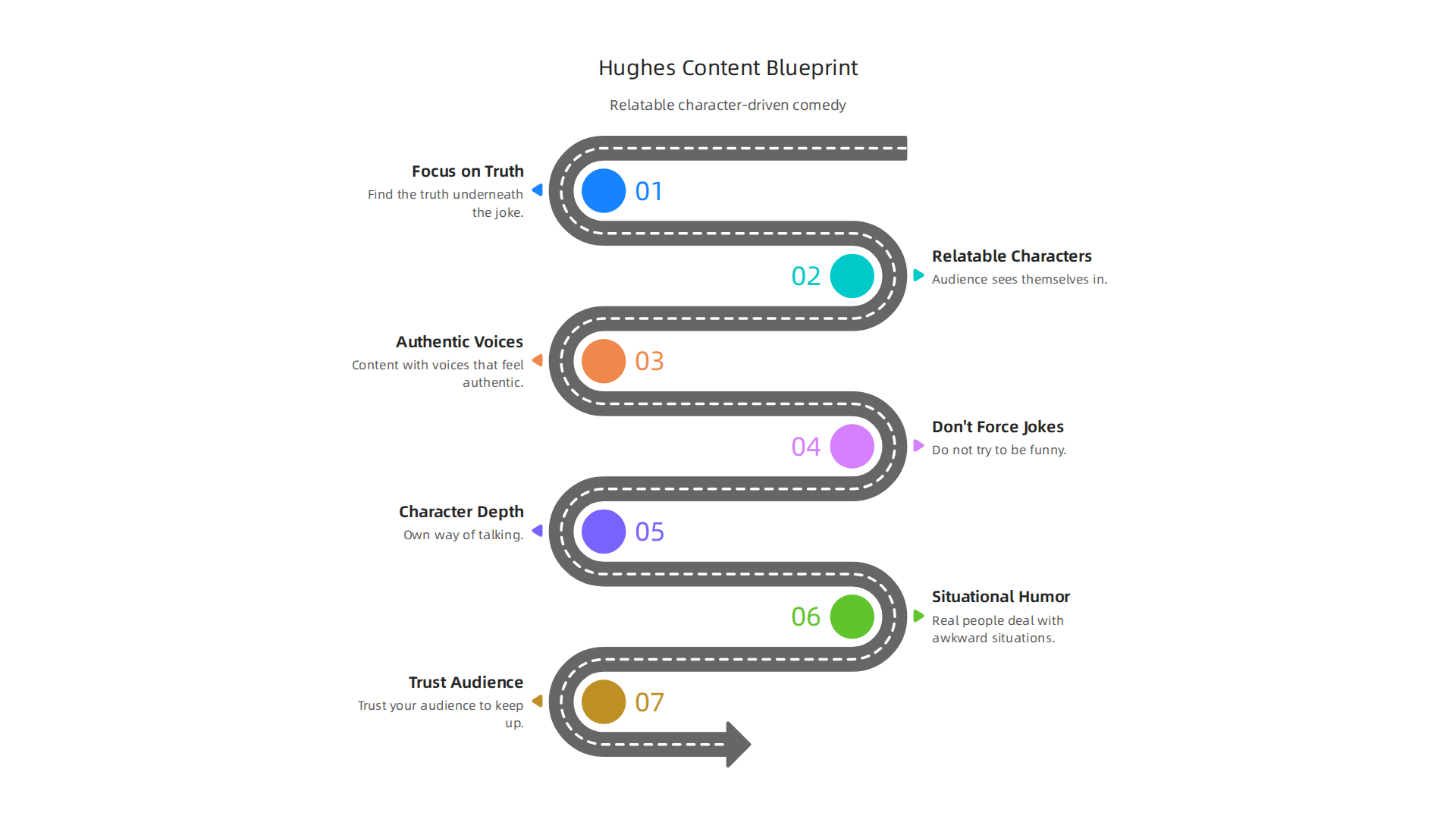

That is the blueprint John Hughes left behind.
And if you love the kind of unexpected, clever comedy that makes you think while you laugh, you will enjoy Try Smarter Absurdity. It is full of the same playful, human spirit that makes John Hughes movies timeless.
From ‘The Breakfast Club’ to ‘Planes, Trains and Automobiles’: Key Films and Their Enduring Appeal
Let’s look at three John Hughes movies that show his range. Each one proves why his approach still works in 2026.
The Breakfast Club changed teen movies forever. Five strangers stuck in Saturday detention. A jock, a princess, a brain, a criminal, and a basket case. On paper, these characters should not have anything to say to each other. But Hughes wrote them with real pain underneath their labels. The jock is scared of his father’s pressure. The brain thinks about suicide. The princess feels invisible to her parents. That honesty made audiences feel seen for the first time. The BFI calls it an essential film because it gave teenagers permission to be complicated. Today, content creators study this movie the same way they study Julia Stiles movies from 10 Things I Hate About You for the way young actors handle raw emotion.
Ferris Bueller’s Day Off took a completely different approach. Ferris is not suffering. He is having the best day of his life. He breaks the fourth wall and talks straight to us. That direct connection with the audience is rare in comedies. It worked because Matthew Broderick played Ferris with pure charm, not arrogance. He made skipping school feel like a victory. The box office numbers prove it. According to TheThings, Ferris Bueller’s Day Off earned $70.7 million in its original run. Adjusted for inflation, that number is much higher. The movie shows that a confident, funny lead character can carry a whole story.
Planes, Trains and Automobiles surprised everyone. This was not a teen movie. It was an adult comedy about two strangers stuck traveling together for Thanksgiving. Steve Martin plays the uptight businessman. John Candy plays the lovable loudmouth. They hate each other at first. But over time, they open up. They share real feelings. The movie is hilarious, but it also made people cry. That is Hughes’ signature move. He made you laugh and then hit you with a moment of real humanity. Rotten Tomatoes gives it a 93% fresh rating, showing how critics still love it decades later. It proves Hughes could write comedy for any age group.
Home Alone belongs in this conversation too. Macaulay Culkin became a star because Hughes wrote Kevin McCallister as a smart, resourceful kid. He was not just a victim. He was the hero of his own story. Ultimate Movie Rankings notes that Home Alone is Hughes’ biggest box office hit. The average John Hughes movie made $107.50 million adjusted for inflation. That number comes from understanding what makes people care.
These four films show one thing clearly. Hughes had a formula, but it was not about plot tricks. It was about truth. The Breakfast Club gave us emotional depth. Ferris Bueller gave us wish fulfillment. Planes, Trains and Automobiles gave us adult vulnerability. Home Alone gave us a kid who fights back.

Every one of those movies is still quoted, streamed, and loved in 2026. Because real human emotion never gets old.
If you love that kind of clever, human comedy, you will enjoy Try Smarter Absurdity. It is packed with the same playful spirit that makes John Hughes movies timeless.
The Hughes Formula: How Character Depth and Wit Outperform Pure Joke Density
You might think great comedy comes from packing in the most jokes. But John Hughes movies prove that is not true. He used a smarter formula. And in 2026, this formula works better than ever.
Instead of just making you laugh, he made you care. That is the real trick.
Hughes made sure every character had their own way of talking. A jock did not sound like a brain. A princess did not sound like a criminal. They had real reasons for acting the way they did. That is character depth.
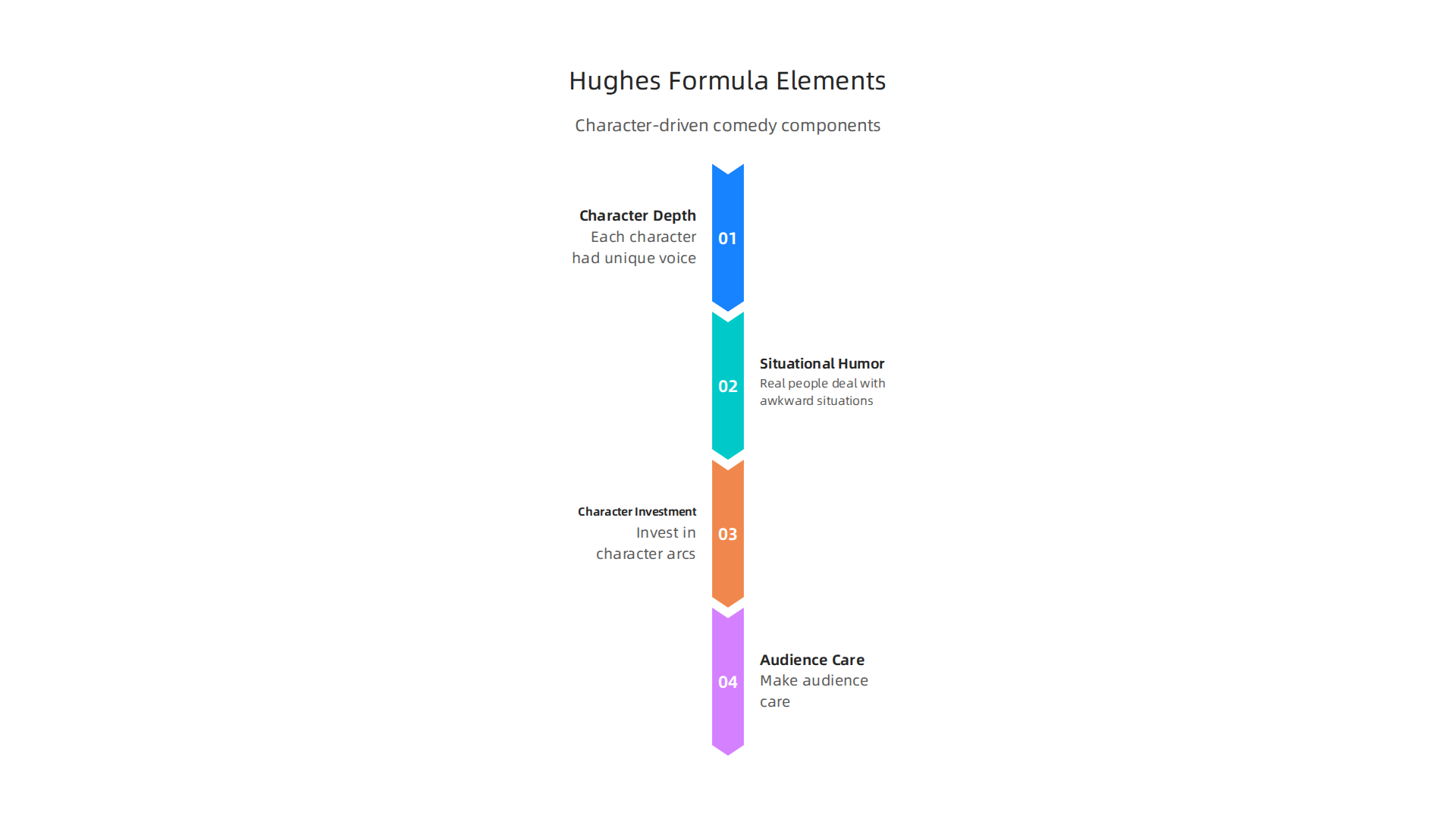
It makes us feel for them. A 2025 Global Comedy Index report found that 68% of Gen Z viewers prefer comedians who "speak directly to their lived experience." Hughes did this long before it was a trend. He gave his characters real pain and real hope. This is why actors like Julia Stiles movies from 10 Things I Hate About You shine in his type of storytelling. The writing makes them look good.
The funny parts did not just come from quick one-liners. The humor came from watching real people deal with awkward situations. Ferris Bueller talking to the camera. The joke is not the line. The joke is that he is breaking the rules and taking us along. John Candy in Planes, Trains and Automobiles. He is not telling jokes. He is just being painfully honest. That situation is funny because it is true. StoryFit examined how character interactions directly impact a story’s success. Hughes understood this perfectly. He knew that if the characters feel real, the comedy writes itself.
Some movies today try to win with high joke density. They throw many gags at the screen. But those movies often feel empty. Do you watch them again and again? Probably not. But you watch Home Alone every Christmas. You watch Ferris Bueller every time you need a boost. That is the power of character investment. It is why a Macaulay Culkin movies list always starts with Kevin McCallister. It is why Brittany Murphy movies still find new fans. It is why Sacha Baron Cohen movies work best when they stick to the character’s truth. Good character writing never fades. Comedy in 2026 is rediscovering this truth. Movies are pushing boundaries by going back to strong, honest characters, just like Hughes did.
This approach works in any genre. It works for black movies, for absurd comedies, and even for action flicks. The core idea is simple. Make the audience care about the person on screen. Then the humor hits harder. It lasts longer. That is why genre-bending comedy films transform your content strategy when you apply this rule. You stop writing jokes and start writing people.
If you love comedy built on character depth and wit rather than cheap laughs, there is more where that came from. Check out Try Smarter Absurdity for a fresh take on smart, human humor that keeps the Hughes spirit alive.
Cult Classics Beyond Hughes: The Parallels in Comedy Filmography
John hughes movies set a high bar. But he was not the only one building great comedy on a foundation of character. Directors like the Coen brothers, Wes Anderson, and Mike Judge built their own cult followings using the same secret. They did not care about joke density. They cared about people.
Look at the Coen brothers. The Big Lebowski is a masterpiece of understated, intelligent humor. The Dude is a character you remember forever. The humor comes from his honest reaction to a strange world. A 2026 report from Ogilvy notes that audiences are actively seeking authenticity and human resonance. The Coen brothers built their career on this principle.
Wes Anderson does the same thing. His movies are instantly recognizable because of his unique characters. He uses a very distinct style to tell very human stories. As TV Tropes highlights, Anderson’s signature style relies on regular use of specific tools to highlight character quirks. His cult classics like Rushmore and The Royal Tenenbaums show that a strong character template creates a versatile comedy format.
Mike Judge took this to the workplace and the suburbs. Office Space is a cult classic because Milton and Peter are painfully real. The comedy is not forced. It comes from the situation. This is a versatile comedy template that works across any setting.
Why does this matter for you in 2026? Because audiences are smarter now. They can spot a shallow joke from a mile away. As content trends in 2026 show, creators need to build meaning into their content. You need to study how these directors build a macaulay culkin movies list that still draws a crowd or how brittany murphy movies remain quotable. You need to see how sacha baron cohen movies push boundaries while staying true to character. You need to look at black movies like Friday and see how character depth turns a comedy into a cultural staple.
These directors prove that the best comedy templates are character first. For more on how this applies to your own creative work, check out our breakdown of how genre-bending comedy films transform your content strategy.
And if you want to see these principles in action, do not just stick to the mainstream. Explore the weird, clever stuff. Head over to Absurd Humor Fans for a series that turns strange ideas into clever comedy. It is a great example of building a cult classic following from the ground up.
Why Intellectual Absurdity Works: Lessons for Modern Content Creators
Ever scrolled through your feed and felt like you have seen the same joke a hundred times? That is the problem with shallow comedy. It blends together. But intellectual absurdity? That sticks. It works because it respects your brain. It does not just try to make you laugh. It makes you think, then laugh.

John Hughes movies understood this better than most. Hughes built his comedies around real characters, not just punchlines. Think about The Breakfast Club or Ferris Bueller’s Day Off. These movies still work today because they feel true. According to a 2025 Global Comedy Index report, 68% of Gen Z viewers prefer comedians who "speak directly to their lived experience." That is the same principle. Audiences do not want jokes that feel like they were written by a committee. They want humor that comes from a real place.
So why does intellectual absurdity work so well in 2026? Here are a few reasons.
First, it creates a sense of discovery. When you watch a macaulay culkin movies list classic like Home Alone, the humor is not just slapstick. It is the cleverness of Kevin setting traps. You feel smart for getting the references. The same goes for sacha baron cohen movies. His characters are so detailed that every scene rewards your attention.
Second, it builds community around a shared understanding. Black movies like Friday or Coming to America have lines that fans quote for decades. That shared language creates loyalty. When a piece of comedy feels like it was made for you, you become a fan for life.
Third, smart humor scales better in the age of algorithms. Audiences in 2026 are demanding simpler, personalized, and purpose-driven content, according to Media in Motion. Intellectual absurdity naturally attracts a niche audience that engages deeply. And deep engagement is what platforms reward.
What can you learn from this?
Lesson 1: Lead with character, not jokes. Whether you are writing a blog post or making a video, start with who the "character" is. Your brand voice should feel like a real person. Research shows that character interaction is a strong predictor of success in drama and comedy. Treat your content like a scene in a movie.
Lesson 2: Embrace your weird side. The most memorable comedies come from directors who stopped trying to please everyone. Look at how brittany murphy movies like Clueless or 8 Mile used her unique energy. She was not a generic comedic actress. She was herself. Your content should feel the same way.
Lesson 3: Trust your audience to keep up. Intellectual absurdity does not explain every joke. It leaves room for the audience to figure things out. That is why John Travolta’s comedic roles in Get Shorty or Pulp Fiction feel so satisfying. The humor is baked into the character’s choices, not shouted at you. For more on how to apply this to your own work, check out how John Travolta comedic roles reveal the formula for niche humor that works.
The bottom line? Stop chasing viral trends and start building characters. That is how john hughes movies became timeless. And that is how your content can build a real following.
Ready to put this into practice? If you want to see what smart, character-driven absurdity looks like, try a series that turns strange ideas into clever comedy. Try Smarter Absurdity for a collection of witty chaos and sci-fi punchlines. It is a great example of how intellectual humor builds a loyal audience.
Summary
John Hughes created comedies that still land because he built humor on human truth, not on punchlines alone. This article explains what made his films—The Breakfast Club, Ferris Bueller’s Day Off, Planes, Trains and Automobiles, and Home Alone—so enduring: richly drawn characters, smart casting, and situations that reveal real emotion. It shows how those choices led to massive box-office success and long-term audience loyalty, and why the same lessons matter for content creators in 2026. You’ll see how Hughes’ mix of warmth, wit, and authenticity produces repeat viewing and quotable moments, and how other directors follow similar playbooks. The piece translates those film lessons into practical guidance for writers, video creators, and brands who want comedy that resonates, explaining when to favor character depth over joke density and how intellectual absurdity can build niche engagement.